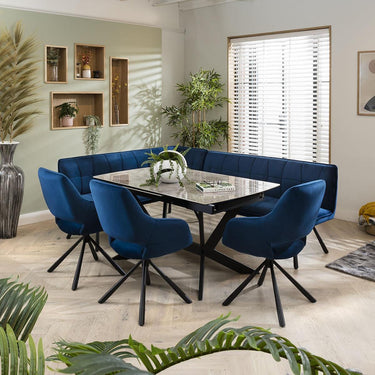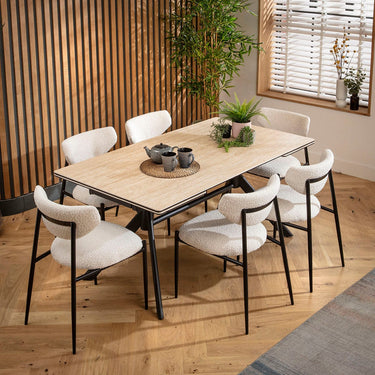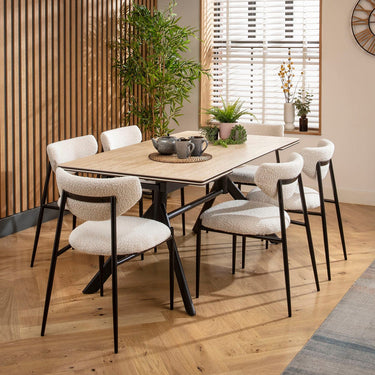


Choosing the right dining table isn't just about deciding how many people you want to seat. The size and shape of your room, the chairs you choose and how you use the space all make a difference.
A table might technically fit in your dining room, but if there's barely enough space to pull the chairs out or walk around it, it probably isn't the right size.
Whether you're looking for a compact dining set for everyday meals, a larger table for family gatherings or an extending dining table that can do both, here's how to find the right fit.
How much space does each person need at a dining table?
As a general guide, allow around 60cm of table space per person. This gives each diner enough room for their place setting and some elbow room without everyone feeling squeezed together.
It's worth remembering that this is a guideline rather than a strict rule. Dining chairs vary in width, and the position of a table's legs can also affect where people can comfortably sit.
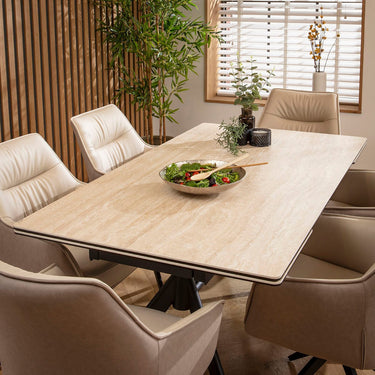
A wide, padded dining chair with arms, for example, will take up more space than a slimmer chair. That's why it's important to look at the table and chair dimensions together when choosing a dining set.
What size dining table do I need?
As a starting point, these are useful size ranges for rectangular dining tables:
|
Number of seats |
Approximate table length |
|
4 seater |
120–150cm |
|
6 seater |
160–180cm |
|
8 seater |
180–220cm |
|
10 seater |
220–260cm |
|
12+ seater |
260cm+ |
These measurements are guidelines rather than fixed rules. The width of the table, its shape, leg position and the size of the chairs can all affect the seating capacity.
A 160–180cm table is a good starting point for a six-seater dining set, while 180–220cm can comfortably accommodate around eight people. For larger households or anyone who regularly entertains, 220–260cm is a useful range for a ten-seater dining table.
For 12 or more people, tables over 260cm can work well, provided your room has enough space around them.
How much space do you need around a dining table?
This is one of the easiest things to overlook when choosing a dining table.
As a general guide, aim for around 90cm of clear space between the edge of the table and the nearest wall, furniture or other obstruction.
This gives you enough room to pull a chair out and sit down comfortably. If the space behind the chairs is also used as a main walkway, you may want to allow around 100–120cm instead.
Don't forget to account for things such as radiators, sideboards, kitchen islands and doors. They can all reduce the usable space around your dining table.
A simple way to check your space
Take the dimensions of your room and work backwards.
For example, if your dining area is 350cm long and you want around 90cm of clearance at either end:
350cm - 90cm - 90cm = 170cm
That gives you roughly 170cm of usable table length.
You can also use masking tape to mark the proposed table dimensions on the floor. Add your chairs and try pulling them out as you would normally. Then walk around the table.
It’s a simple way to see whether a table that looks right on paper will actually work in the room.

Choosing the right dining table shape
The shape of your room can help determine which dining table works best.
Rectangular tables are one of the most versatile options, particularly in longer or open-plan rooms. They make good use of the available space and are a popular choice for larger dining sets.
They're also ideal if you need plenty of seating without taking up unnecessary floor space at either end.
Round dining tables can work particularly well in square rooms and smaller dining areas.
Without corners, they're easy to move around and can create a more sociable layout, with everyone sitting around the same central point.
Just remember that as the diameter increases, a round table can still require a considerable amount of floor space.
Oval tables offer something between a rectangular and round design.
You get the longer seating area of a rectangular table, while the curved ends can give the room a softer feel and make moving around the table easier.
They're a great option if you want a larger dining table without the sharper lines of a traditional rectangle.
Are extending dining tables worth it?
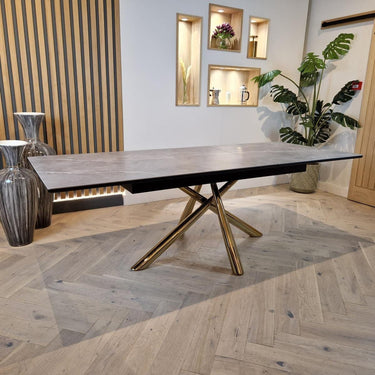
If you regularly have extra guests but don't want a large table taking up your dining room every day, an extending dining table can be a particularly practical choice.
You can keep it compact for everyday meals and extend it when you need additional seating.
For example, a four-to-six or six-to-eight-seater extending table can work well for a household that normally needs fewer seats but regularly entertains.
When choosing an extending table, don't just look at its everyday dimensions. Check the fully extended size too, and make sure you still have enough space to pull out the chairs and move around it.
Don't forget about the dining chairs
The table isn't the only thing that needs to fit.
Before buying, check:
-
The width of each dining chair
-
Whether the chairs have arms
-
The depth of the chairs
-
Where the table legs are positioned
-
How far the chairs need to pull out
-
How much space is available behind them
This is particularly important if you're buying a table and chairs separately. A table advertised as a six-seater doesn't necessarily work with six wide, oversized dining chairs.
If you're choosing a complete dining set, check the individual dimensions of both the table and chairs rather than relying only on the advertised seating capacity.

What size dining table is best for a small dining room?
Having a smaller dining area doesn't necessarily mean you have to compromise on seating.
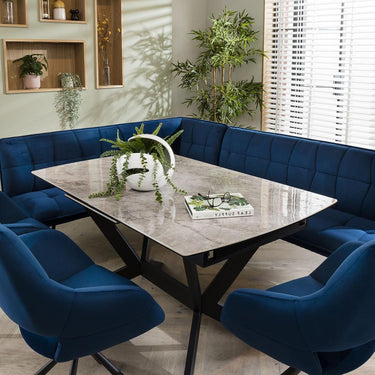
Think about how you use the table every day. If you normally need four seats but occasionally host six or eight people, an extending table can give you more flexibility without permanently taking up the extra floor space.
Round tables can also work well in smaller spaces, particularly where you need to move around the table regularly.
The key is to measure the whole dining area, not just the space where the tabletop will sit.
Finding the right dining table size
There's no single perfect dining table size. The right choice depends on your room, your household and how you actually use your dining space.
Start by working out how many people you normally need to seat, then consider how often you entertain. From there, look at the dimensions and shape of your room, the space needed around the table and the size of your dining chairs.
And if you're deciding between two sizes, don't just ask whether the table will fit.
Ask whether you'll still have enough room to sit down, stand up and walk around it comfortably.
Because there's fitting a dining table into a room, and there's having enough room to actually enjoy using it.
Quatropi Means Quality - Our Promise, Your Guarantee
Investing in your home is about more than just furniture - it’s about creating a place you love to spend time in. At Quatropi, we believe in helping you do just that. When you choose a piece from us, you’re investing in years of enjoyment.
Ready to upgrade your home interior?
🛒 Explore Ceramic dining tables
🍽️ Shop our wide range of Dining Room Furniture
🪑Discover our market-leading Dining chair Collection
✅ Relax... It's Quatropi
If you have any questions about our furniture collections - from corner sofas to egg chairs - our expert team is ready to assist. We're here to help you find the perfect piece for your home and ensure a seamless shopping experience.